


Martin Parr and the Legacy That Shaped Contemporary Photography
Martin Parr, one of the most defining voices in late-20th and early-21st-century photography, passed away on December 6th, 2025, at age 73. Known for his unapologetically vivid documentation of everyday life, Parr elevated the ordinary, the awkward, and the overlooked through a visual language rooted in color, satire, and sharp social observation. His loss marks a turning point for contemporary photography, closing a chapter written across five decades of persistent curiosity.

A relationship with Arles that shaped a generation
Parr’s long affiliation with Rencontres d’Arles became one of the essential through-lines of his career. His breakthrough moment came in 1986, when François Hébel invited him to exhibit The Last Resort and Bad Weather: two early works that signaled his radical shift toward saturated color and a more humorous, incisive gaze.
He returned in 2004 as guest curator, broadening the festival’s scope and spotlighting emerging voices. A later 2015 collaboration with musician Matthieu Chedid reaffirmed Parr’s instinct for experimentation—connecting sound, image, and performance in unexpected ways.
Through these chapters, Parr not only participated in Arles; he helped define what the festival could be for photographers and audiences alike.

Recasting everyday life in color and contradiction
Parr’s work is a continuous exploration of the everyday—tourism, leisure, weather, consumer rituals, and family life—rendered through a lens that reveals cultural contradictions. His images expose the tension between how people want to be seen and how they truly behave.
‘Most of the time people are looking for a form of reality which is perfect… that doesn’t exist,’ Parr once said.‘So I come along with my camera and show people the flaws that we all know we have.’
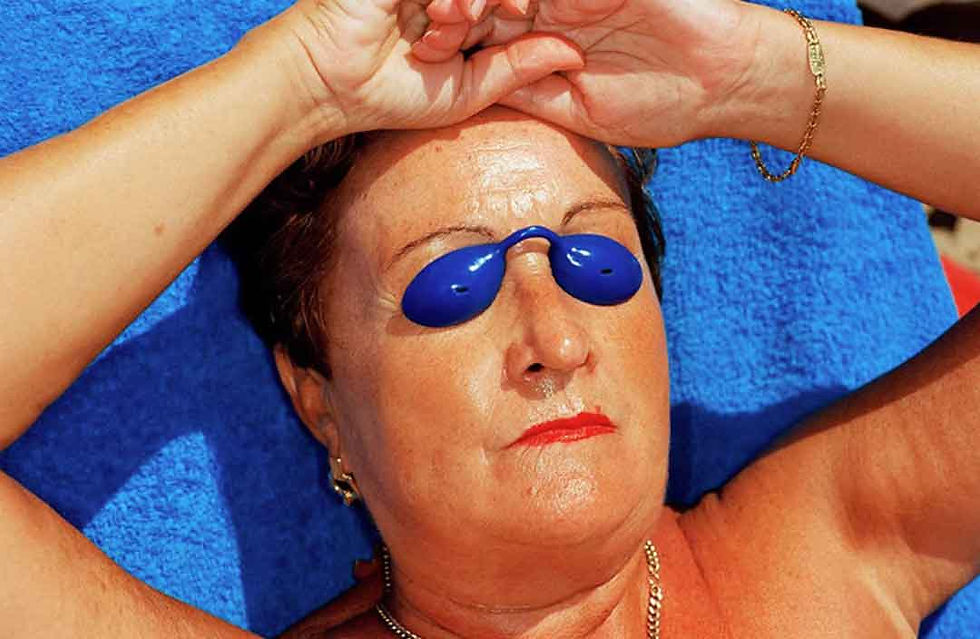
This approach, often built using a macro lens and ring flash, created a heightened but truthful version of reality—humorous, sharp, and deeply human.
Key bodies of work illustrate his evolving sociological map:
The Last Resort (1983–85): working-class leisure in New Brighton through intense, saturated color.
The Cost of Living (1987–89): Britain’s middle class during the Thatcher years.
Small World (1987–94): mass tourism as global theatre.
Common Sense (1995–99): the spectacle of consumer culture through bold, tactile imagery.
Across these projects, Parr used humor not as dismissal, but as method—a way to approach complexity without moralizing or distancing.
Beyond the camera: curator, editor, collector, institution builder
Parr’s impact extends into the infrastructure of photography itself.As a member (since 1994) and later president (2013–2017) of Magnum Photos, he influenced both the agency’s direction and how documentary photography circulates globally.
He curated key festivals, including:
Rencontres d’Arles (2004)
Brighton Biennial (2010)
Strange and Familiar at the Barbican (2016)
As an editor and collector, Parr championed the photobook as a vital medium. His 12,000-volume collection became the foundation for the Arles exhibition 50 Years, 50 Books in 2019.
In 2017, he founded the Martin Parr Foundation in Bristol—an archive, exhibition space, and educational platform dedicated to preserving photographic culture and broadening public access. Its mission mirrors Parr’s own ethos: photography as democratic, engaging, and culturally honest.
Martin Parr contemporary photography - A legacy of curiosity
Parr often described his upbringing in suburban Surrey as pivotal precisely because it was unremarkable:‘If you can tolerate that, everywhere else becomes exciting.’This early awareness of the ordinary as a site of meaning guided him throughout a career that traveled from Hebden Bridge to Greece, Japan, and beyond.
His work now sits in major institutions including the Tate, MoMA, and Centre Pompidou—evidence of a career that consistently expanded how the medium sees the world.
Martin Parr leaves behind not only photographs, but a way of looking: humorous but incisive, accessible yet critical, always attentive to what people reveal when they think no one is watching.

Written by Otávio Santiago, a designer crafting visual systems that move between the tactile and the digital. His work combines motion, branding, and 3D exploration with a poetic sense of structure.



Comments