


What Was the First Electronic Music Album? And What Did It Look Like?
Electronic music has accumulated such a recognisable visual vocabulary that it is difficult to imagine a time before it. We associate it with grids and machines, geometric typography and synthetic colour, anonymous figures, industrial landscapes, computer-generated forms and images of futures that seem alternately utopian, clinical or already obsolete. These associations have been repeated across record sleeves, clubs, flyers, magazines and screens for decades, to the point that electronic music can often be recognised visually before a note has been heard.
There was, however, a moment when none of these conventions existed. Electronic music was new enough that its terminology remained unstable, its instruments unfamiliar and its cultural position uncertain. Much of it emerged not from stages or conventional recording studios but from broadcasting institutions, universities and corporate research laboratories, where oscillators, filters, tape machines and electrical circuits were being used to reconsider what a musical sound could be. When these experiments eventually began appearing on commercially available records, another question emerged alongside the musical one: how could this new and largely invisible process be given an image?
Asking what the first electronic music album was therefore opens a surprisingly complicated history. There is no single record that can claim the title without qualification, because electronic composition existed before electronic albums, electronic soundtracks could reach millions without being commercially released as records, and experiments created for tape belonged to a different cultural context from the electronic popular music that followed. Yet this ambiguity is precisely what makes the question interesting.
Somewhere between the laboratory, the cinema, the radio broadcast and the record shop, electronic music became not simply a technical experiment but a cultural object — something that could be packaged, circulated, collected and, importantly, designed.
Before Electronic Music Became an Album
The history begins long before electronic music became a genre in the contemporary sense. During the late 1940s and early 1950s, several different approaches to electronically mediated sound were developing simultaneously. In Paris, Pierre Schaeffer and the composers associated with musique concrète treated recorded sounds from the physical world as raw material, cutting and manipulating fragments of trains, voices, instruments and machinery. In Cologne, the emerging tradition of elektronische Musik pursued a different logic, constructing compositions from electronically generated tones. Across the Atlantic,
American composers were discovering magnetic tape not simply as a recording technology but as a compositional space in which sound could be reversed, repeated, accelerated, slowed down and reorganised.

These practices were related, but they did not yet form the unified cultural category we now casually call electronic music. They belonged as much to post-war science, broadcasting and experimental composition as they did to the record industry. Their studios were filled with equipment that had not necessarily been invented for musicians, and their methods often resembled engineering as much as conventional performance. The composer was increasingly able to work directly with recorded sound, constructing a piece through processes that had no equivalent in an orchestra or traditional studio.
This shift would eventually transform popular music, but in the early 1950s its implications were still being discovered. The studio was beginning to change from a place where a performance was captured into a place where the work itself could be produced. Electronic music was not simply introducing unfamiliar sounds; it was destabilising the relationship between instrument, performer, composer and recording.
One of the clearest early examples of this transformation came from a small private studio in New York.
Bebe and Louis Barron: A Music Made by Circuits
Bebe and Louis Barron established their electronic music studio in New York in 1948, working with magnetic tape at a moment when the technology itself was still relatively new in the United States. Their approach would become unusually radical. Rather than relying exclusively on existing electronic instruments, Louis Barron constructed circuits capable of generating complex and often unpredictable sounds, while Bebe organised, edited and transformed the recordings using tape.

Their thinking was influenced by cybernetics and, in particular, the idea that complex systems could behave in ways that appeared almost organic. The circuits were treated less like stable musical instruments than temporary electronic organisms. They produced sounds, changed as they operated and could eventually burn themselves out. The Barrons recorded these behaviours and then worked with the resulting material, manipulating fragments until they became compositions.
The Library of Congress identifies works including Heavenly Menagerie from 1951 and For an Electronic Nervous System No. 1 from 1953 among their early experiments. What makes the method historically significant is not simply that electricity was involved, but that the technology participated directly in generating the musical material. There was no conventional performance waiting to be documented. Composition increasingly took place through circuitry, recording and editing themselves.
This unusual practice found its largest audience in 1956, when the Barrons created the soundtrack for MGM's science-fiction film Forbidden Planet.
Forbidden Planet: When Electronic Sound Entered Popular Imagination
Watching Forbidden Planet today, it is easy to understand why electronic music became so closely associated with science fiction. The Barrons' soundtrack surrounds the fictional planet Altair IV with unstable oscillations, pulses, resonances and electrical textures that seem to belong neither to conventional instruments nor to recognisable earthly environments. The electronic sound does not simply accompany the film's technology and alien landscapes; it helps make them imaginable.

Even the credit given to the Barrons reveals how unfamiliar the territory remained. Their work was described not as a conventional musical score but as “Electronic Tonalities.” The terminology reflects both a practical industry problem and a broader cultural uncertainty. These sounds occupied an ambiguous territory between composition and sound effect, between music and technology, and the existing language of film production did not comfortably accommodate them.
The soundtrack became one of the earliest occasions on which a large mainstream audience encountered a feature-length score built entirely from electroacoustic material. It also reinforced a connection that would shape electronic music for decades: if traditional instruments belonged to the familiar world, electronic sound could suggest environments that had not yet been encountered. Electricity became a sonic shorthand for advanced technology, distant planets, artificial intelligence and futures still waiting to arrive.
For a history of the electronic album, however, Forbidden Planet introduces an important complication. MGM did not release the complete Barron soundtrack as a commercial LP in 1956. Its historical importance as electronic music is undeniable, but its importance as an electronic album belongs to a different chronology. The sounds reached cinemas around the world while the record itself remained absent from contemporary shelves.
This distinction may appear technical, but it reveals something essential about the question of origins. Electronic music could exist publicly before it existed as the kind of designed, reproducible object we recognise as an album. To find another part of that story, we need to leave Hollywood and travel to a corporate laboratory in Eindhoven.
From the Philips Laboratory to the Record Player
During the 1950s, Philips operated one of Europe's most important industrial research environments at its NatLab laboratories in Eindhoven. The company's interests extended across electronics, acoustics and emerging media technologies, creating an environment in which scientific research and musical experimentation could temporarily overlap. Here, oscillators, filters, reverberation systems, tone generators and magnetic tape could be approached not only as engineering equipment but as components of an entirely new musical process.
Among the figures working within this environment were Dutch composer and technician Dick Raaijmakers, who would release some of his electronic work under the name Kid Baltan, and musician Tom Dissevelt. Their recordings occupy an intriguing position in electronic music history because they began moving away from the austerity of academic electronic composition toward shorter, rhythmic forms that could circulate as entertainment.

Raaijmakers' Song of the Second Moon, created in October 1957 under the working title Electronische Rumba, is perhaps the most famous example. The composition was assembled from electronically generated tones and manipulated tape, yet its rhythm and compact structure gave it a character quite different from much of the experimental electronic music surrounding it. It did not abandon the laboratory, but it suggested that the laboratory could produce something unexpectedly close to pop.

Its final title also captured the cultural atmosphere with almost suspicious perfection. In October 1957, the Soviet Union launched Sputnik 1, placing the first artificial satellite into Earth's orbit and transforming space technology from speculative fiction into immediate reality. Song of the Second Moon emerged at precisely the moment when satellites, radio transmissions, rockets and orbital movement were becoming part of everyday imagination. Electronic music suddenly seemed capable of providing a soundtrack to a future that was no longer entirely fictional.
The piece was commercially released by Philips in June 1958 on a 7-inch record, paired with an electronic interpretation of Colonel Bogey. This makes it especially important when discussing the origins of electronic popular music. It was not the first electronic composition, nor can it solve the question of the first electronic album, but it represented a significant shift in format and audience. Electronic sound was leaving the specialist studio and entering the domestic record collection.
The distinction is subtle but culturally important: listeners no longer needed access to a laboratory, radio broadcast or experimental concert to encounter it. Electronic music had become something that could be purchased, carried home and replayed.
The Electronic World Becomes an LP
Tom Dissevelt continued working with electronic composition at Philips, combining the possibilities of studio technology with an interest in rhythm and jazz. Together, the recordings associated with Dissevelt and Kid Baltan began to form a small but remarkably forward-looking body of work. Pieces such as Syncopation, Vibration, Whirling and Drifting suggested that electronically constructed music could have movement, humour and immediacy without surrendering its experimental character.
Several of these compositions circulated first on smaller formats. Around the end of 1959, Philips released the EP Electronic Movements, already presenting electronic sound not merely as a technical curiosity but as an identifiable musical proposition. The title is revealing because it names the technology while simultaneously suggesting motion, composition and perhaps even a new genre still searching for its boundaries.

The material eventually found a more substantial form in May 1963 with the Philips LP The Fascinating World of Electronic Music, credited to Kid Baltan and Tom Dissevelt. The record gathered eight compositions — including Syncopation, Intersection, Drifting, Vibration, Song of the Second Moon, Whirling, Mechanical Motions and Pianoforte — into something that could be encountered as a coherent electronic environment rather than an isolated experiment.
Whether it should be crowned the first electronic music album is debatable, and doing so would erase several parallel histories. Its significance lies somewhere more interesting. By the time this LP appeared, electronic music was being presented to the listener as a world in its own right, complete with a title that invited exploration and a graphic identity designed to make an unfamiliar form of music legible before the needle touched the record.
The cover is where the story of electronic sound becomes inseparable from the history of visual culture.
How Do You Design Music That Has No Instrument?
The sleeve of The Fascinating World of Electronic Music is striking partly because of what it refuses to show. There is no heroic photograph of the composers, no orchestra, no singer leaning toward a microphone and no futuristic machine presented as a substitute protagonist. Instead, the predominantly white composition is crossed by overlapping bands of colour that expand and contract around a horizontal axis, suggesting waveforms, frequencies and oscillations without becoming a literal scientific diagram.
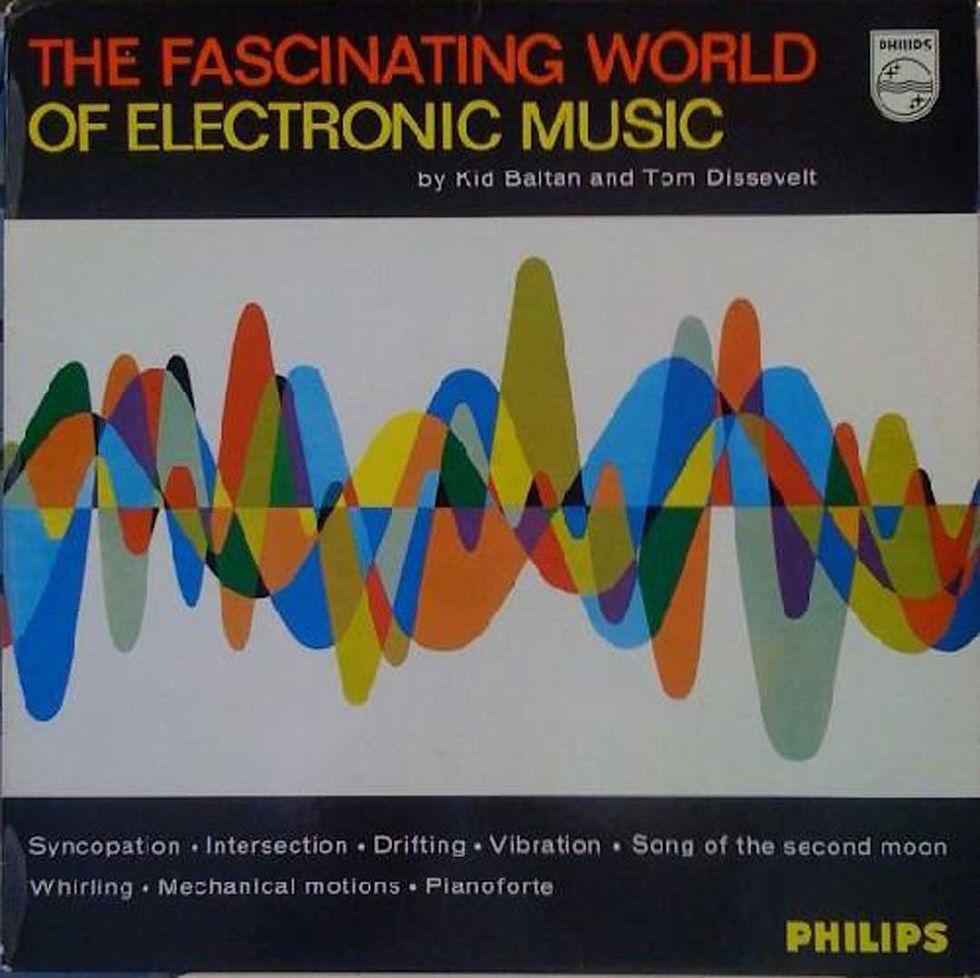
The title sits above this field in straightforward modern typography, while the Philips identity remains clearly present. The overall composition feels simultaneously technical and playful, occupying a territory between information design, scientific illustration and modernist abstraction. Rather than inventing a fictional image of the musicians, the sleeve turns toward the phenomenon that actually defines the record: sound transformed by technology.
This is more radical than it might initially appear. The portrait had long provided the record industry with one of its most dependable visual devices, allowing audiences to connect music with a face, a body and a recognisable performance. Electronic composition complicated that relationship because its most important actions could happen invisibly, through circuits, magnetic tape and studio processes. Photographing the performer no longer necessarily explained the origin of the sound.
Graphic abstraction offered another possibility. If the music itself could be constructed from waves, frequencies and electrical signals, then those same systems could become visual material. The disappearance of the conventional instrument created space for diagrams, geometry and typography to assume a new cultural role.
Electronic music was beginning to develop an image through the visualisation of processes that could not otherwise be seen.
Seeing Sound: The Waveform as Cultural Image
A waveform occupies a peculiar position between evidence and metaphor. In an engineering context, it can describe measurable behaviour; on a record sleeve, the same visual language can become expressive, decorative and symbolic. It appears objective while simultaneously suggesting movement, energy and transformation.
The coloured forms on The Fascinating World of Electronic Music exploit precisely this ambiguity. They resemble information without requiring the viewer to understand any information at all. The visual reference to frequency and oscillation is enough to communicate that this music belongs to another technological order.
What is particularly compelling from a contemporary perspective is how optimistic that order appears. Later electronic genres would repeatedly turn toward black, metallic surfaces, industrial infrastructure and dystopian technological imagery, but this early Philips sleeve belongs to a different conception of the future. Its colours overlap with an almost educational brightness, closer to the visual optimism of post-war science exhibitions and modernist information graphics than to the alienation that would later accompany the machine aesthetic.
Even the title, The Fascinating World of Electronic Music, presents technology as an invitation. Electronic music is framed as a territory to enter, a phenomenon to discover and a glimpse of possibilities that conventional instruments could not provide. The future here is not yet threatening. It is fascinating precisely because it appears open.
Space, Technology and the Invention of an Electronic Imaginary
The waveform was only one of several visual languages available to designers trying to give electronic sound a cultural identity. The other great source was space.
The relationship was almost inevitable. The post-war development of electronic music coincided with an extraordinary expansion of technological imagination: satellites entered orbit, television became domestic, computers began appearing in public consciousness, nuclear technology reshaped geopolitics and the Space Race transformed distant planets into potential destinations rather than purely astronomical objects.
Electronic sound belonged naturally to this environment because its source could remain ambiguous. Where the timbre of an acoustic instrument carried centuries of cultural familiarity, an electronically generated tone could suggest a machine, a transmission, an artificial environment or an object for which no visual equivalent yet existed.

The Philips recordings themselves reveal how thoroughly this imagination had entered the language surrounding the music. Titles such as Song of the Second Moon, Orbit Aurora, The Visitor from Inner Space and Sonik Re-Entry positioned electronic sound within a world of satellites, orbital movement and speculative travel. These titles did more than provide colourful names for abstract compositions; they helped listeners interpret unfamiliar sounds by connecting them to another unfamiliar territory that was rapidly entering popular culture.
Record design followed the same logic. Planets, stars, orbital lines, technical diagrams, abstract geometries and images of machinery became ways of telling audiences that the music belonged to the future. The electronic record sleeve developed at the intersection of modernist graphic design, scientific communication and science fiction, borrowing from each without belonging completely to any of them.
In retrospect, many of these visual conventions can appear charmingly retro-futuristic. At the time, however, they were attempts to represent a future that had not yet acquired the patina of nostalgia. The designers were not referencing “vintage electronic music”; they were trying to make the contemporary technological world visible.
Before Electronic Music Had an Aesthetic
This is perhaps the most interesting aspect of looking at these records today. The people designing early electronic music sleeves could not reference an established electronic-music aesthetic because such an aesthetic did not yet exist. There was no archive of techno typography, rave graphics, computer glitches, chrome lettering or anonymous 12-inch sleeves waiting to be quoted, rejected or reinterpreted.
Instead, designers borrowed from adjacent visual systems that already carried associations with modernity: scientific diagrams, engineering, corporate research, geometric abstraction, information graphics, astronomy and the visual culture of the Space Age. Through repetition, these borrowed languages gradually became attached to electronic sound itself.
This is how genres acquire visual identities. The relationship between a sound and an image can initially be arbitrary or contextual, but repeated associations accumulate cultural memory. A waveform that once functioned as a relatively direct symbol of electronic technology eventually becomes a historical reference. A grid can evoke systems, machines or techno; fluorescent colour can suggest rave culture; certain forms of condensed typography can recall club flyers or industrial design. What feels intrinsic to a genre is often the result of decades of visual repetition.
Electronic music is particularly rich in this respect because its history repeatedly coincides with changes in technology. Each generation has inherited an existing visual language while gaining access to new machines and new forms of image production, from analogue photography and Letraset to photocopiers, early computer graphics, desktop publishing, 3D software and contemporary generative systems.
The visual history of electronic music is therefore not simply a sequence of styles. It is also a history of how designers imagined technology at different moments in time.
From Philips to Kraftwerk, and From the Laboratory to the Club
By the 1970s, the relationship between electronic sound and visual identity had become far more sophisticated. Kraftwerk would be particularly important in transforming technology from subject matter into an entire system of representation. Their use of controlled typography, repetition, uniforms, machines, transport networks and depersonalised imagery presented the group itself almost as an engineered object. The distinction between music, artwork, performance and identity became increasingly difficult to separate.

Later electronic cultures would push these ideas in different directions. Industrial music could turn technology into a language of control, infrastructure and anxiety, while house and techno developed identities through the economies of independent labels, clubs, flyers and 12-inch records. In many cases, anonymity became an aesthetic strategy rather than a limitation. The absence of the artist's portrait, already implicit in early electronic records, could become part of the mythology.
Rave culture complicated the picture again, replacing some of the restraint of modernist and industrial design with visual excess: fluorescent colour, distorted typography, psychedelic references, computer-generated imagery and symbols circulating between music, fashion and underground publishing. Digital culture would subsequently introduce another set of visual possibilities, until electronic music became associated not with one aesthetic but with an enormous family of visual languages.
Yet many of the fundamental questions remain surprisingly close to those faced by designers in the 1950s. How should invisible processes be represented? How can technology become emotional rather than merely technical? How can repetition create recognition without becoming static? And how can a visual system establish an atmosphere before the audience encounters the sound itself? The machines have changed, but the problem has not disappeared.
So, What Was the First Electronic Music Album?
There is no completely satisfying answer, because the question changes depending on where the boundary is drawn. If we are looking for the beginnings of electronic composition, we need to move considerably earlier than the records discussed here and into the histories of tape music, musique concrète and electronically generated sound. If we are interested in the moment a mass audience encountered a completely electronic feature-film score, Bebe and Louis Barron's Forbidden Planet in 1956 is indispensable, even though the soundtrack was not issued as a commercial LP at the time.
If the question concerns electronic music moving toward popular recorded form, Kid Baltan's Song of the Second Moon, created in 1957 and released by Philips in 1958, represents one of the most compelling early examples. If, instead, we are looking for an LP that presents electronic music as a coherent world to be entered and experienced, Kid Baltan and Tom Dissevelt's The Fascinating World of Electronic Music from 1963 becomes especially significant.
Trying to force these histories into a single winner risks missing the more interesting transformation connecting them. Electronic music did not suddenly appear as a finished genre with an established audience, format and aesthetic. It migrated gradually between laboratory, radio, cinema and record player, changing its cultural meaning as it moved. Its visual identity developed in much the same way, accumulating references from science, abstraction, modernism, engineering and speculative images of the future.
The first electronic album may therefore be less interesting as a fixed historical title than as a threshold: the moment when a new kind of sound became something that required not only listening but also looking.
When a New Sound Needed a New Image
What these early records reveal is that the history of electronic music cannot be separated entirely from the history of images surrounding technology. Every major shift in electronic sound has produced new visual questions because electronic music repeatedly changes the relationship between what we hear and what we can see.
A traditional musical performance offers an immediate visual explanation of its sound: bodies, gestures and instruments occupy the same space as the music. Electronic production can break that connection. The decisive event might occur inside a circuit, on a strip of magnetic tape, within software or through a process that leaves no obvious image behind. Graphic design enters this absence and gives the invisible process a cultural form.
For the designers working around early electronic music, waveforms, diagrams, planets and geometric abstraction were not yet clichés. They were attempts to construct a visual vocabulary for a technological reality that had only recently become imaginable. In doing so, these sleeves helped establish associations that electronic culture would spend the following decades expanding, contradicting and rediscovering.
This may be the most compelling legacy of records such as The Fascinating World of Electronic Music. Their covers were not simply containers for experimental sound, nor were they decorative attempts to make difficult music commercially attractive. They participated in the larger process through which electronic music became culturally legible, translating an invisible world of oscillation, tape and circuitry into images that listeners could recognise and remember.
Long before electronic music acquired the enormous visual archive it has today, somebody first had to decide what a sound made by electricity should look like.
Written by Otávio Santiago, a graphic designer exploring visual identity, motion, and the relationship between sound, rhythm, and visual culture.




Comments