


Black Spatial Tradition Architecture: Portland’s Grain Silos Reimagined as a Cultural Complex
The transformation of a former grain terminal along Portland’s Willamette River into a cultural complex marks a significant moment for Black spatial tradition architecture in contemporary urban design. Known as the Albina Riverside project, the proposal reframes adaptive reuse not only as a material strategy, but as a cultural and spatial act of repair.

Designed collaboratively by US studios AD—WO, MALL, and Wayside Studio, the project reclaims a neglected industrial waterfront once used by international grain company Louis Dreyfus Co. Commissioned by the 1803 Fund, the initiative seeks to create a site for play, ritual, learning, and collective assembly — embedding cultural meaning directly into the architectural framework.
At the heart of the project is the reuse of forty-six existing concrete silos. Rather than erasing their industrial past, the design weaves arts, leisure, sport, and hospitality into the cylindrical structures, transforming infrastructure once tied to extraction into spaces of social and cultural production.

The masterplan introduces a network of programmatic elements: an Art Shed screened with wooden slats housed in the silo headhouse, an open-air Art Cube pavilion, an all-season Basketball Shed, and a sixteen-storey hotel. These components are connected by an elevated processional terrace known as The Crossing, which stitches together circulation, gathering, and ritual movement across the site.
Material choices reinforce this balance between memory and renewal. Reused concrete, mass timber, and pre-oxidised copper sit alongside repurposed steel salvaged from existing structural frames and conveyor systems, allowing the architecture to visibly carry its past into a new cultural present.
Black Spatial Tradition Architecture as Cultural Repair
The Albina Riverside project is explicitly grounded in Black spatial tradition architecture, a framework that reclaims undervalued or marginalized sites and animates them as places of joy, creativity, and assembly. Rather than imposing a singular monument, the design creates multiple scales of encounter — from intimate artistic spaces to large civic terraces — encouraging collective ownership of the landscape.

One of the project’s most significant gestures is the Articulated Dock, a two-level, 53,500-square-foot structure that brings visitors into direct contact with the river. Terraced planters, a wading pool, and stepped edges dissolve the boundary between architecture and water, reframing the riverfront as an accessible and participatory environment.
Landscape design plays a reparative role in this vision. Wetlands are terraced and organized into four ecological zones that respond to water flow, habitat restoration, and human movement. As visitors move across the site, vegetative bands shift from upland forest to scrubland, wet meadow, and slough — mirroring a gradual transition from infrastructure to ecology.
Expanded pedestrian and bicycle pathways weave through these zones, connecting the site to broader riverfront networks and reinforcing the project’s role as a civic connector rather than an isolated destination.
Equally important is the collaborative process behind the project. The design team describes a fluid exchange between architects, graphic designers, and the project’s commissioners, underscoring collaboration as both a method and a value embedded within the architecture itself.
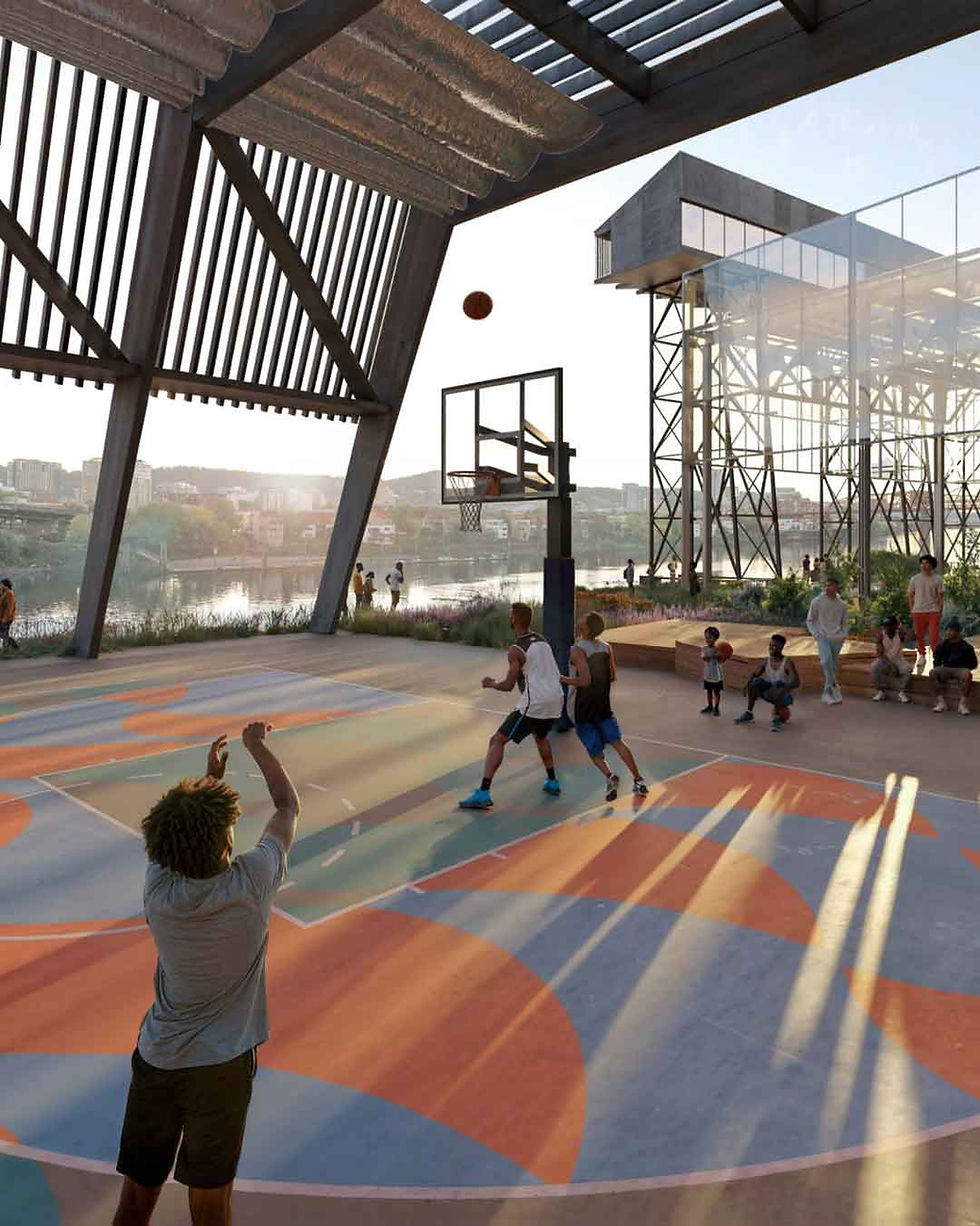
In repositioning industrial ruins as cultural infrastructure, the Albina Riverside project demonstrates how Black spatial tradition architecture can operate as a form of urban storytelling — one that transforms extraction into expression, and neglect into collective presence.
Written by Otávio Santiago, a visual designer whose work blends clarity, rhythm, and storytelling. Between Berlin and Lisbon, he creates across print, motion, branding, and immersive 3D environments.
📣 Social Media Caption (reflective CTA)
When adaptive reuse becomes cultural repair, architecture changes its role.How does Black spatial tradition architecture reshape neglected urban sites?




Comments