


Rediscovering the Mazda Suitcase Car: The Portable Vehicle That Fit Inside a Samsonite
A Forgotten Experiment in Portable Mobility

In the early 1990s, long before micro-mobility became a global obsession, Mazda quietly engineered one of the most unusual vehicles in automotive history: the Mazda suitcase car. Designed as a compact, three-wheeled vehicle that could be stored inside a hard-shell Samsonite suitcase, the project explored the boundaries between transportation, portability, and industrial design.
Created between 1989 and 1991, the concept emerged from Mazda’s internal innovation program known as Fantasyard—a company-wide initiative that encouraged engineers to experiment freely with future mobility ideas. The result was not a marketing stunt, but a fully functional prototype intended to solve a real problem: moving efficiently through large airports.
Engineering a Vehicle That Fits in Luggage
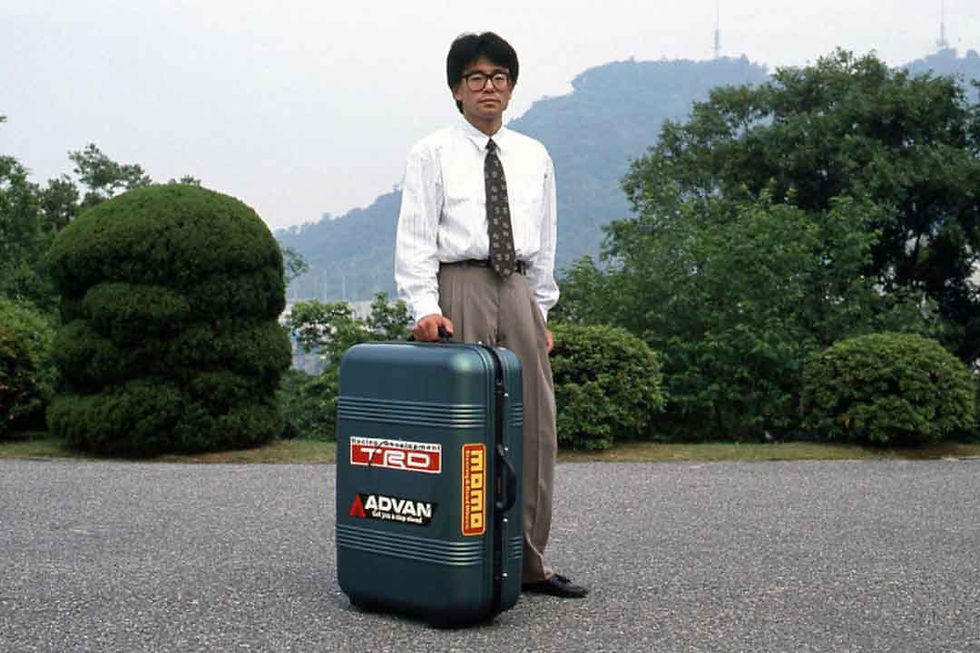
The Mazda suitcase car was developed by seven engineers from the company’s manual transmission testing and research unit. Working with limited resources, the team combined a pocket bike with the largest hard-shell Samsonite suitcase available at the time, measuring approximately 57 × 75 cm.
Inside the case lived a 33.6 cc two-stroke engine producing 1.7 PS, while key components were cleverly modularized. The handlebars folded into the suitcase, the rear wheels attached externally, and the front wheel emerged through a removable hatch. Assembly took roughly one minute, transforming ordinary luggage into a rideable vehicle.
Fully assembled, the portable car weighed around 32 kg and reached a top speed of 30 km/h (19 mph). Though compact, the design demonstrated Mazda’s deep understanding of balance, mechanical efficiency, and spatial problem-solving—qualities that would later define many of the brand’s mainstream vehicles.

Design DNA and Historical Continuity
Despite its playful appearance, the Mazda suitcase car carried strong genetic ties to the company’s past. Its three-wheel configuration echoed the Mazda-Go from 1931, a motorized rickshaw that marked the brand’s earliest steps into vehicle manufacturing. Meanwhile, its low center of gravity reflected engineering principles later refined in the MX-5 roadster.
This continuity highlights an important aspect of the Mazda suitcase car: it was not an isolated curiosity, but part of a broader design philosophy focused on lightweight construction, efficiency, and human-scaled mobility.
Fantasyard, Media Attention, and a Concept That Never Reached Production
The early 1990s were a defining moment for Mazda. The company was experiencing global success with the MX-5, had just won the 24 Hours of Le Mans in 1991 with the rotary-powered 787B, and was actively exploring alternative propulsion systems such as hydrogen rotary engines.
Within this climate of experimentation, Fantasyard allowed small teams to develop concepts with minimal oversight and modest budgets. The Mazda suitcase car gained significant media attention following its reveal, prompting the company to build two versions: one for Europe and one for the United States.
The European version appeared at the 1991 Frankfurt International Motor Show alongside the legendary 787B. Unfortunately, the original prototype was accidentally destroyed months later. Today, the U.S. version is believed to still exist, likely in the hands of a private collector, while the European model has disappeared.
Why the Mazda Suitcase Car Still Matters
Although it never entered production, the Mazda suitcase car remains a powerful symbol of experimental thinking in automotive design. Decades before electric scooters, folding bikes, and modular transport systems flooded cities, Mazda was already questioning the scale, ownership, and purpose of personal mobility.
Today, as airports, cities, and designers revisit portable transportation solutions, the Mazda suitcase car feels less like a novelty and more like a prescient vision. It represents a moment when engineers were given freedom to imagine mobility without market pressure—and in doing so, created something genuinely ahead of its time.
Written by Otávio Santiago, a designer crafting visual systems that move between the tactile and the digital. His work combines motion, branding, and 3D exploration with a poetic sense of structure.




Comments