


Blue Temple Builds Earthquake-Resistant Modular Bamboo Housing in Myanmar for the Price of a Smartphone
Modular Bamboo Housing for Extreme Conditions
The modular bamboo housing project in Myanmar developed by Blue Temple in collaboration with Housing Now demonstrates how architecture can respond to crisis with precision, speed, and dignity. Located in the Bago region, the initiative delivers low-cost, earthquake-resistant homes designed for communities affected by conflict and natural disasters.
Each unit can be constructed in just seven days and costs approximately 1,000 USD—an amount the architects describe as “the price of a smartphone.” Despite this modest budget, the homes have already proven their resilience, surviving a 7.7 magnitude earthquake since completion.
Rather than relying on imported systems or complex technologies, the project focuses on local materials, local labor, and repeatable construction logic.

Earthquake-Resistant Design Using Local Bamboo
At the core of the project is a seismic-resistant structural system engineered entirely from bamboo. Blue Temple designed prefabricated frames that carry all seismic loads, allowing internal layouts to remain flexible without compromising safety.
The structures are formed from bundled, small-diameter bamboo elements, interlocked and strapped together using a jig-guided assembly process. According to Blue Temple founder Raphaël Ascoli, this method achieves timber-grade strength while maintaining a fully local supply chain.
In Myanmar, bamboo is both abundant and affordable, making it an ideal material for scalable housing solutions under extreme constraints.
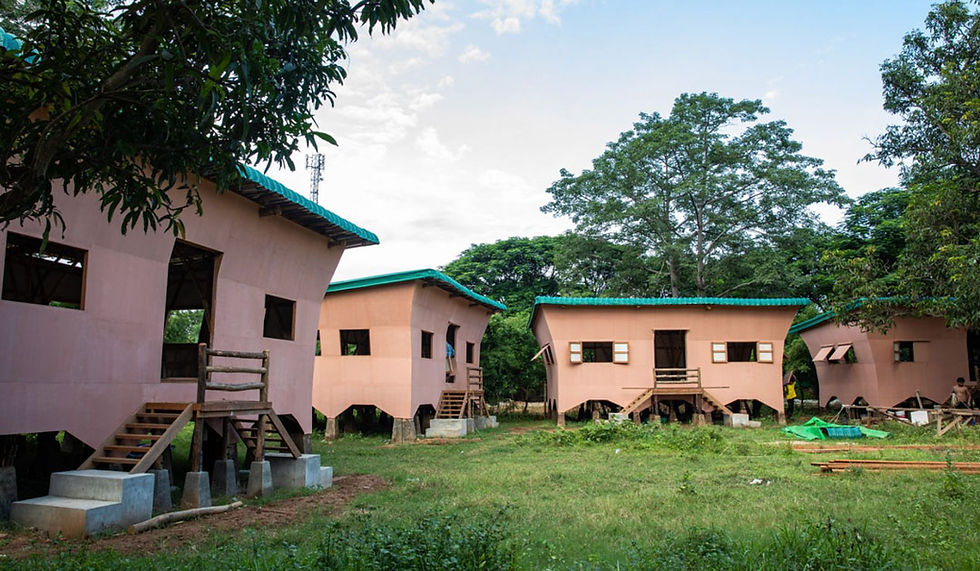
Architecture Shaped by Geometry, Not Style
The visual identity of the modular bamboo housing emerges directly from its structural logic. Raised on concrete plinths and sheltered by sloping roofs with deep overhangs, the homes are designed to withstand heavy rainfall, seismic activity, and environmental stress.
Large operable windows are integrated into textured façades, improving ventilation and daylight while reinforcing the buildings’ climatic performance. Inside, non-structural partitions allow residents to adapt layouts to their needs without affecting the seismic integrity of the structure.
As Ascoli explains, the project avoids stylistic excess:
“The aesthetics are the direct result of field-engineered geometry—clarity through necessity, not styling.”

Housing as Open-Source Infrastructure
Beyond delivering individual homes, the broader ambition of the Housing Now Modular Bamboo Housing project is to establish a replicable construction model. The system is intentionally designed to be copied, adapted, and deployed by others facing similar challenges.
By combining prefabrication, local knowledge, and material intelligence, Blue Temple proposes a form of architecture that functions as open-source infrastructure—capable of responding quickly to humanitarian, environmental, and geopolitical crises.
In regions where conventional construction is slow, expensive, or inaccessible, this approach reframes architecture as a tool for resilience rather than permanence.
High-Performance Architecture Under Extreme Constraints
Blue Temple’s modular bamboo housing in Myanmar illustrates how high-performance architecture does not depend on high cost or advanced industrial systems. Instead, it emerges from an understanding of context, material behavior, and structural logic.
By delivering safe, dignified housing for the price of a smartphone, the project challenges conventional assumptions about affordability, durability, and architectural value—positioning bamboo not as a temporary solution, but as a sophisticated material for the future of resilient design.

Written by Otávio Santiago, a multidisciplinary designer exploring the intersection of emotion, form, and technology. His practice spans graphic, motion, and 3D design, bridging digital and physical experiences.




Comments