


The White Tower: 3D-Printed Architecture as a Structural and Cultural Experiment
Updated: Feb 15
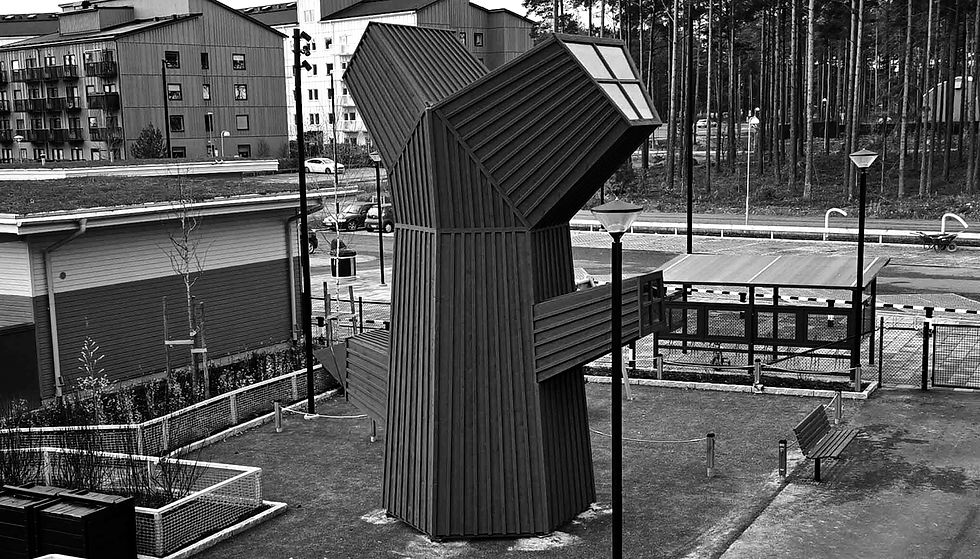
The White Tower represents more than a formal or aesthetic exploration — it stands as a tangible experiment in how 3D printing technologies are reshaping architectural production. Rather than treating additive manufacturing as a novelty, the project positions it as a viable construction method capable of redefining structure, material logic, and spatial expression.
As large-scale 3D printing moves from prototype to real-world application, projects like the White Tower mark an important transition point for contemporary architecture.

Architecture Printed, Not Assembled
Traditional construction relies on assembling standardized elements: beams, panels, bricks, and finishes. In contrast, 3D-printed architecture operates through continuous material deposition, allowing structure, surface, and enclosure to emerge simultaneously.
In the White Tower, this logic becomes visible through layered textures and uninterrupted structural flows. Walls are not composed of separate parts but generated as single, continuous systems, where load-bearing capacity and surface articulation are inseparable.
This approach challenges long-established hierarchies between structure and envelope, proposing a more integrated architectural language.
Material Intelligence and Structural Efficiency
One of the key promises of 3D-printed architecture lies in material optimization. Instead of adding material uniformly, digital fabrication allows matter to be placed precisely where it is structurally required.
The White Tower demonstrates this principle through its controlled geometry and thickness variation. Structural density increases where loads are concentrated and recedes where it is unnecessary, reducing material waste while maintaining stability.
This computational approach aligns architecture more closely with engineering logic, producing forms that are not arbitrary, but direct responses to performance criteria.
New Aesthetics from Construction Logic
The visual identity of the White Tower is inseparable from its method of production. Layer lines, surface rhythms, and subtle imperfections are not decorative effects but traces of the printing process itself.
Rather than concealing these marks, the project embraces them, allowing fabrication logic to define architectural expression. This results in an aesthetic that feels simultaneously precise and organic — shaped by algorithms, yet grounded in physical material behavior.
Such an approach signals a shift away from polished, anonymous surfaces toward architectures that communicate how they are made.
From Prototype to Architectural Typology
While many 3D-printed structures remain experimental pavilions or temporary installations, the White Tower suggests the emergence of a more permanent architectural typology. Its scale and complexity point toward a future where additive manufacturing could be applied to housing, infrastructure, and civic architecture.
Challenges remain — including regulation, long-term durability, and scalability — but projects like this serve as critical test cases. They provide valuable insights into how digital fabrication can integrate with existing construction ecosystems rather than replace them entirely.

Why 3D-Printed Architecture Matters Now
As the construction industry faces increasing pressure to reduce waste, labor intensity, and environmental impact, 3D printing offers an alternative model — one based on automation, precision, and adaptability.
The White Tower illustrates how these technologies can move beyond efficiency alone and contribute to architectural culture. It proposes new spatial possibilities, new material expressions, and new relationships between design intent and built form.
More than a singular object, the project operates as a statement about architecture’s future, where code, material, and structure converge into a single, continuous process.
Written by Otávio Santiago, a designer passionate about creating meaningful visual experiences through graphic, motion, and 3D design. Based between Berlin and Lisbon, he works across disciplines — from print and branding to digital and animation.





Comments